
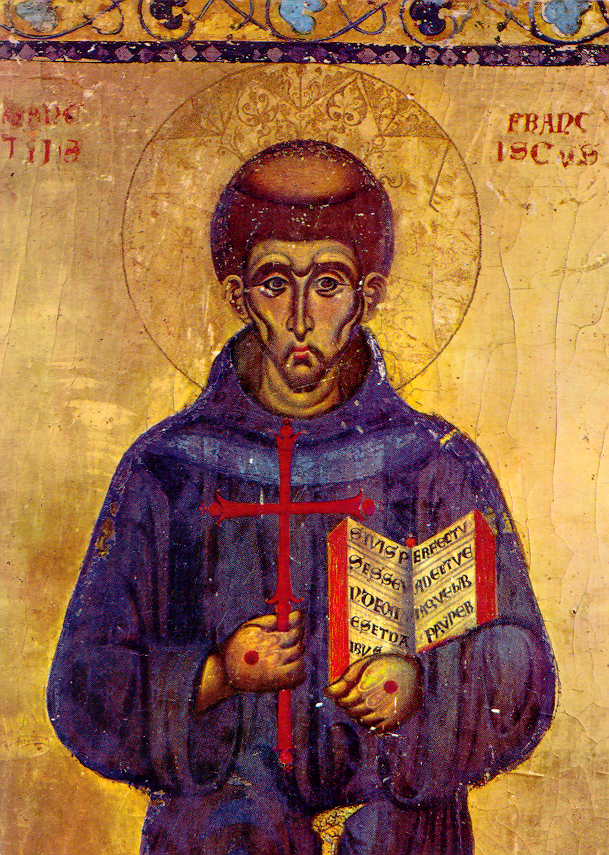
St. Francis of Assisi is not the proto-hippy earth-warrior – he is the Saint of the Eucharistic Lord. Without understanding this, we miss the source of his love of poverty and the poor, of fraternity and of creation. Goodness, the “Prayer of St. Francis” hymn was written in French in 1912, and set to music in English in 1967. As one historian writes:
The most painful moment usually comes when [students] discover that Saint Francis did not write the “Peace Prayer of Saint Francis”… Noble as its sentiments are, Francis would not have written such a piece, focused as it is on the self, with its constant repetition of the pronouns “I” and “me”, the words “God” and “Jesus” never appearing once. (Augustine Thompson)
His Testament, now 800 years old, presents Francis’ final words – nothing about Creation but first about Jesus Christ humbling Himself totally in the Eucharist and the requirement that this Mystery and Presence be properly honoured in “becoming buildings” and “becoming vessels”.
And God inspired me with such faith in his churches that I used to pray with all simplicity, saying, “We adore you, Lord Jesus Christ, here and in all your churches in the whole world, and we bless you, because by your holy cross you have redeemed the world.”
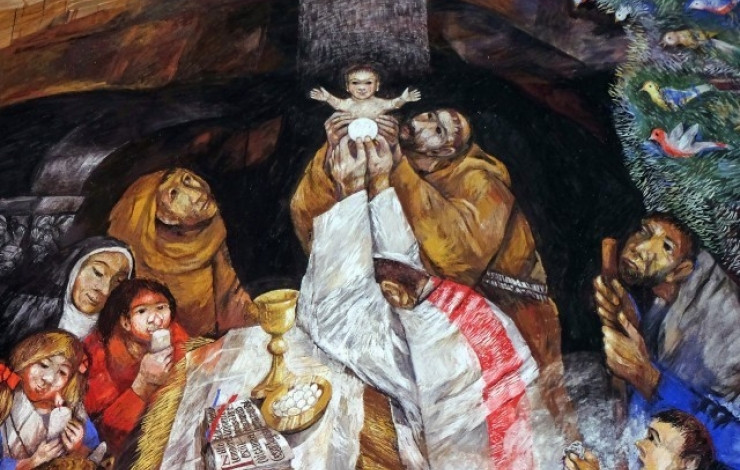
God inspired me, too, and still inspires me with such great faith in priests who live according to the laws of the holy Church of Rome, because of their dignity, that if they persecuted me, I should still be ready to turn to them for aid. And if I were as wise as Solomon and met the poorest priests of the world, I would still refuse to preach against their will in the parishes in which they live. I am determined to reverence, love and honour priests and all others as my superiors. I refuse to consider their sins, because I can see the Son of God in them and they are better than I. I do this because in this world I cannot see the most high Son of God with my own eyes, except for his most holy Body and Blood which they receive and they alone administer to others.
Above everything else, I want this most holy Sacrament to be honoured and venerated and reserved in places which are richly ornamented. Whenever I find his most holy name or writings containing his words in an improper place, I make a point of picking them up, and I ask that they be picked up and put aside in a suitable place. We should honour and venerate theologians, too, and the ministers of God’s word, because it is they who give us spirit and life.
Here is his beautiful meditation sent to the General Chapter of the Friars:
Let the entire man be seized with fear; let the whole world tremble; let heaven exult when Christ, the Son of the Living God, is on the altar in the hands of the priest. O admirable height and stupendous condescension! O humble sublimity! O sublime humility! that the Lord of the universe, God and the Son of God, so humbles Himself that for our salvation He hides Himself under a morsel of bread. Consider, brothers, the humility of God and “pour out your hearts before Him”, and be ye humbled that ye may be exalted by Him. Do not therefore keep back anything for yourselves that He may receive you entirely who gives Himself up entirely to you.