
Christ is risen, Alleluia. He is risen indeed. Alleluia.
Is not it wonderful that just like the disciples who came back to tell the apostles that Jesus had risen only to hear from the apostles, “He is risen indeed” so every Sunday, I get to come and say to you, “Christ is risen.” And you say, “Yeah, we know it. He s risen indeed.” He is in our midst today.
Mane nobiscum Domine. So, monks for centuries would end their day saying, “Stay with us, Mane nobiscum, quoniam advesperascit, et inclinata est jam dies., because it’s almost evening, and the day is nearly done.” So too our prayer [at] the end of the day, at the beginning of the day, in the middle of the day, [is] “stay with us, Lord”.
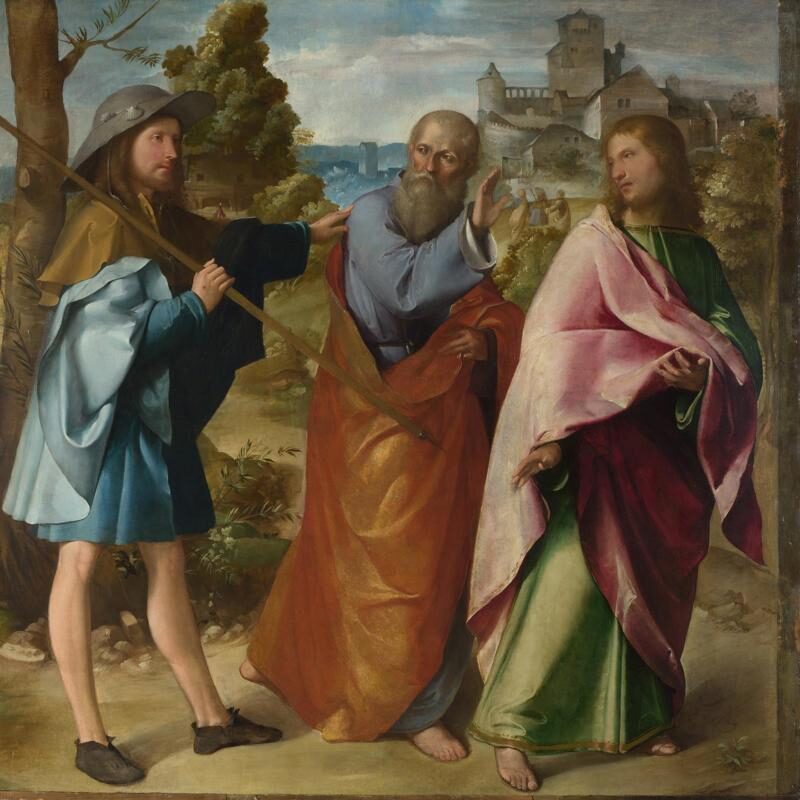
Yet we meet two people who are devastated because it seems that the Lord is not staying with them, that it has all meant nothing. These two disciples wandering back [to Emmaus] seven kilometers, going back to the place that they came from having followed Jesus, and yet, as the French would say with a wonderful word, déçu. [Decú] means to be more than just disappointed. It means to be deceived, to just feel totally let down. They’re going back, and they’re talking on this evening walk. They’re talking. The word in Greek for them talking and discussing all the things that had happened is homilein. Homily. They were having a homily, talking. And just like my homilies, it was kind of empty. They didn’t know where it was going to go. But suddenly in this walk, they find someone walking with them. We’re told it is Jesus. This is the first time in Luke’s gospel that Jesus appears. We have not seen him. He has not been seen and touched, until this moment, at the time of the very first Sunday mass.
That’s what today’s gospel presents to us: the first Sunday Eucharist. “The first day of the week”, which is also the last day of the week, the Lord comes and leads these disciples as He leads us every Sunday through a reflection. The first reflection is to address them where they are. “What are you discussing with each other while you walk along?” What is going on? What are you talking about? What are you thinking about today? What’s on your mind? What’s distracting you?
What’s distracting me? I was worried earlier because I could hear all these kids talking in the [sacristy], and I said, “Uh-oh, it’s the Kolla boys. They’re taking apart my sacristy.” But then I realized that there are holes in the floor, and you can hear everything from the basement. .. so, they’re not doing that. Thanks be to God. But we all have things in our mind that we worry about. And these two disciples are really worried, really sad. Luke tells us “they stood still, looking sad”. And then they give to Jesus perhaps the most heartbreaking line in the whole of scripture: ” But we had hoped that he was the one to redeem Israel”… You know, we knew this Jesus of Nazareth, but we had hoped that he was the One. We’d hoped he was the one to redeem Israel, and our hope is broken.
[We understand this sadness] I hoped that this kid amongst all my kids would be the one that would get [the faith and practice it]… I hoped that this job would fulfill me… I hoped that this course of treatment would be what was going to heal me… I hoped that my relationship with this person was going to fill me with life… I’d hoped…, but now I’m sad because my heart is broken. We had hoped that Jesus was the one to fulfill all things.” And the Lord says to them, “Oh, you foolish people. Let me tell you, this was all foretold. This is all in God’s plan. Read the whole of the scriptures.”
The Old Testament, you and I know, is written by the same hand of the Spirit who wrote the New Testament. It isn’t just that the prophets, it isn’t just that the psalmists and a few places in the Old Testament spoke about what the Messiah was going to have to do, that his life would be one ending with suffering and coming to glory. The whole of all of the scriptures tells you that what you think is a situation of heartbreak is all in the hands of God. He opens their minds to that so that all of a sudden it’s no longer a distracted homily that they have, but a conversation that brings everything together. Brothers and sisters, that’s what’s happening right now.
We heard the word of God. You and I on our journey with our distractions and what preoccupies us, meet the Word of God explaining to us what is happening in our life. Explaining that we’re not alone. Did you not understand that suffering is part of the journey? That joy is waiting for us? Read all the scriptures. I’ve been tasked to break open that word. Never as well as the Lord, but trying to be the Lord’s voice, letting the scripture speak to us. That’s what we do at Sunday Mass. [Something happens to us] just as something happens to these two.
Even though they don’t recognize that this is Jesus, [His] explanation stirs them so that all of a sudden, they get out of being caught up with their stuff. You know how in our minds we mull over things so that we really just are stuck? Without thinking about it, you can’t see anybody else. It’s all you. It’s all about you. Your victimhood, your suffering, your annoyances, your fears, your pains. All of a sudden in this conversation that happens in the Word, [the two] become attentive to the guy that is with them. They’ve reached home…yet they’re worried about him. «Hey, the night is coming.It’s late. Stay with us. Come and stay with us». They’re thinking about him.
We’re going to do that in a moment. The end of our sharing of the Word, we’re going to start thinking about other people. We’re going to pray for the world, for peace, for the people that are sitting next to us, for those who have died, for those that are broken in their bodies and in their minds and are worried. We’re going to get outside of ourselves, having heard the Word of God, and begin to pray, knowing that others need our prayer.
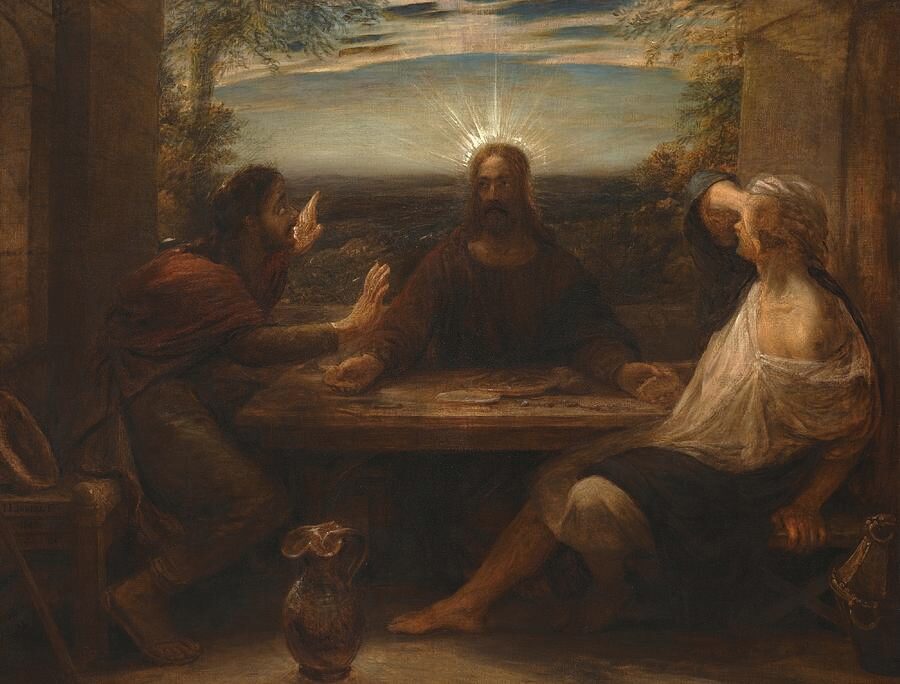
Rhey invite him, as we invite this one walking with us, to ‘come in’. And then the scripture tells us that He “was at table with them”. Bad translation. As he reclined at table with them. The words [now used] are exactly the same as in an earlier passage when Jesus, on the night before He died, “He took bread, and when he had given thanks, he broke, and gave it to them, saying “καὶ λαβὼν ἄρτον εὐχαριστήσας ἔκλασεν καὶ ἔδωκεν”. [Kai lambo arton eucharistes eklasen kai edoken otois lego]. The same words are used here in Emmaus.[ καὶ ἐγένετο ἐν τῷ κατακλιθῆναι (reclined at table) αὐτὸν μετ’ αὐτῶν λαβὼν (took) τὸν ἄρτον (Bread) εὐλόγησεν (blessed) καὶ κλάσας (broke) ἐπεδίδου (hand (over to)) αὐτοῖς] Kai egeneto ento kataklis thnai.
“He reclined at supper”. Do you notice that when I consecrate, when the priest is asked to consecrate, the rubrics tell us we are to bow, to recline? Because people [in the time of Jesus] didn’t sit at table. They lay down at table. So, like the Lord, the priest reclines. And then the same thing happens with the disciples on the road to Emmaus as happened at the Last Supper, as happens with us. He takes bread. He blesses bread. He gives thanks for bread. He breaks the bread and he hands it over to them.
This is the way in which the Lord stays with us. For 2,000 years, He has given us this gift that you and I receive. The gift that makes us Christians. It’s not just by our actions that they know we are Christians. No. Christians are those who come in their journey and gather for the Breaking of the Bread. [We gather] Not just for the word. Not just for community. Not just for a Word to build them up. But to actually meet the risen Lord in the breaking and the giving of the bread. For He reclines, he takes, He blesses, He breaks, and He gives. That is what happens this morning. All around the world, as for centuries, millions of Christians, of Catholics, gather with Jesus as He takes, blesses, breaks, and gives. Then He goes.
For they have seen Him, the Resurrected One, as He wants to come to us. You see, resurrection doesn’t just mean that his body comes back to life. No. It is a body. It is real. It can be tasted. It can be touched. It can be listened to. But it also can appear to disciples locked in a room, and it also can take the form of bread and wine and be present with us. And receiving this, what do these disciples do? They go back. It’s been a long journey… Hard getting to mass this morning. We’ve had a long week. It’s been a long time getting here… What do they do? They go all the way back to Jerusalem. Why? Because they have good news. The Lord is risen. They want to tell everyone that the Lord is risen.
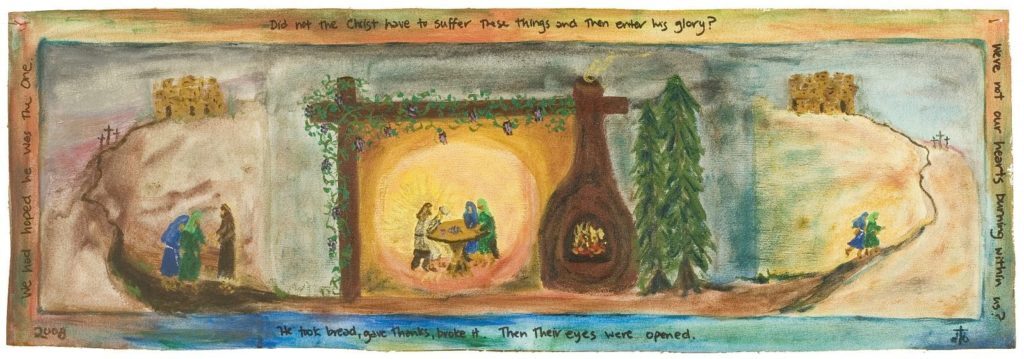
So, too, for us. We come, we kneel in adoration of what the Lord is able to do. If we’re able to kneel, we kneel. Some of us can’t kneel because we our time of kneeling is done. But we kneel in adoration to receive the One who sends us out with good news.
Brothers and sisters, this gospel is what happens every time we come to Mass.
Brothers and sisters, this gospel is the explanation for us, more eloquent than all the homilies that I could possibly give on the mystery of the Eucharist, for it is the real story of the first Sunday mass, and that Mass didn’t end. It continues without end into the glory of God.
Let us walk with him.
Let us bring our sadness and our joy to him.
Let us rest and listen to Him explain to us throughout the week through the Word what is really happening in our lives and where we are going.
Let us get over ourselves and pray and love others because you and I have met the Lord who reclines, who blesses, who breaks, and who gives Himself so that you and I can give Him to others.
How simple! How glorious that we can do this in the power of the Spirit and so become saints.
So let us be holy. Let us be saints.