
Christ is risen, Alleluia. He is risen indeed, Alleluia. Carissima famiglia. My dearest family. Well, what a wonderful word Jesus says to us in the gospel today. “What my Father has given me is greater than all else, and no one can snatch it out of the Father’s hand” (Jn. 10:22). That would be me and you. The Father has given us to Jesus. And He tells us how precious we are, how loved we are. Greater than all else. Boy, that would be a pretty arrogant way of thinking about ourselves if we were trying to convince ourselves that that was the truth of who we are. But it’s the voice of the Lord who speaks. That in His eyes, how great we are.
Our call is to live that greatness. Indeed, in a mediocre world. So let us go with the Lord now to the “holy mountain where the city of the Lord is founded” on this feast of Saint Louis Grignion de Montfort. Louis lived a relatively short life by our accounts, 43 years. He was the second of 18 children! And both his parents outlived him. He was born of a really devout family and since his father was a lawyer, they were folks of means with good connections, part of the rising middle class that was in France at the time.
Almost exactly the period of his life paralleled a real shift towards secular rationalistic thinking in which the traditions of the Church were beginning to be eroded by a deep focus on the self and on the way in which the self knows and orders the world. Now, the Church in France was caught up very much in this struggle, both politically, because of Gallicanism, which saw the king at that time, Le Roi Soleil, Louis XIV, appointing and running the Church. He was of course interested in using the power of the French Church for himself and also he had a great deal of interest in the theological debates that were going on at the time. These debates engaged secular rationalism that seemed to pooh-pooh any authority of the Tradition of the Church, and on the other hand, a movement in the Church called Jansenism, which itself was extremely rationalistic and looked at the mystery of God and said, “Boy, we can’t do anything in the face of that. We just have to simply surrender ourselves in utter faith and hope, hope against hope, that we’re not predestined to hell.” Minimizing again the authority of Tradition.
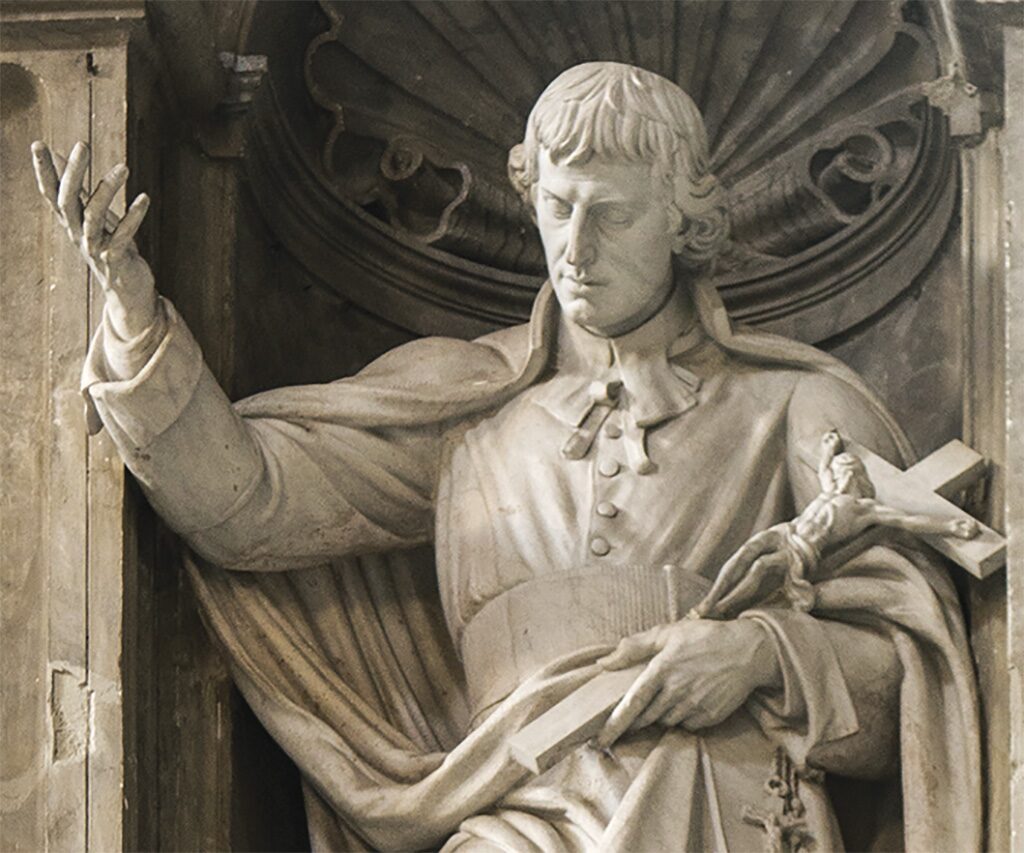
Louis, raised as he was in this family of faith, saw his life as preaching clearly to a generation that was really confused. People were either turned off by the Church because it was so political, or they, at least the intellectuals, wrote it off because, well, they were more brilliant in their minds than any of the Tradition that preceded them. And that even went for those Jansenists who had a harsh approach to Christianity that ended up elevating themselves as being pretty particularly special.
Louis was an effective preacher of the tradition of the Church, particularly concerning someone who had been neglected. Though she was treasured by France before, our Blessed Mother didn’t figure in to the modern spirit of the times. That meant that Louis’ priesthood was one of deep suffering. Mostly suffering at the hands of bishops who were either political hacks or Jansenists. They didn’t like this kind of preaching that stirred people to turn to the Blessed Virgin Mary and to realize that one could have a deep personal relationship with our God as shown through the tenderness with which He gives us His Blessed Mother. His preaching emphasized the devotional life of the Church, through the Stations of the Cross, and especially through the Rosary, as way in which people could know that loving presence of God.
He was banned from several dioceses. In fact, the place in which now pilgrims from all over the world go in order to pray the Stations of the Cross that were built as a Calvaire on a hilltop which had been built after Louis’s preaching and people pooling their money, the bishop, who was totally politically correct and a Jansenist, had it condemned and got Louis XIV to pull it down and destroy it. All bishops die, as do kings, as do priests. When they’d finished dying, the people of God put up the Calvaire again, the Stations of the Cross. And then the French Revolution came about along, and the government destroyed it again. But all states and ideologies die. And so when these had died, the people built again the Stations of the Cross. So today pilgrims can meet the One that St. Louis pointed to as the anchor that allowed people to know how great they were because God had given them to Jesus. Through the hands of this Mother who held Jesus, who holds us so that we can know how we are held by Jesus, we are able to weather all the politics of this world which don’t amount to a hill of beans because on the hill of Calvary, all sin was destroyed. And the truth that shapes reason stood up in victory because the truth that shapes reason that was shaped in the truth was shaped in the womb of the Mother who died to herself to say ‘yes’.
That truth that defeats all the brokenness of the world is the love that dies for another: Jesus. Let us give thanks then that at various moments the Lord raises up good, holy, Catholic families who raise their children to be able to keep, despite persecution from outside and within the Church, to keep the people of God focused – by the intercession of Mary – on Jesus, in whom is found true greatness and love.
Like Louis de Montfort, let us be holy. Let us be saints.