
Homily for the Third Scrutiny of Luke and Annika, St. Paul’s Co-Cathedral, March 22, 2026
Fr. Stefano Penna
We adore You O Christ and we praise You. Because by Your Holy Cross you have redeemed the Word.
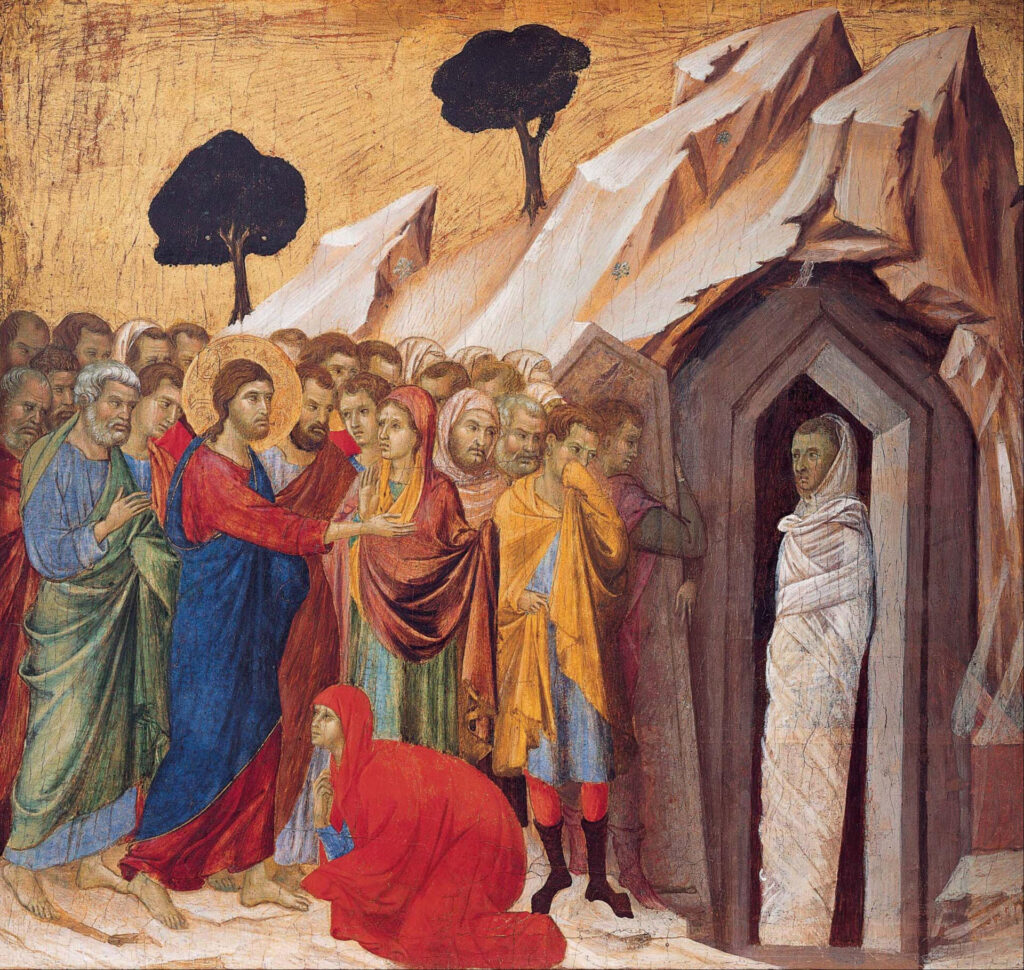
The name Lazarus means “God helps” – and in this Gospel we see how God helps in a way beyond our expectation. Lazarus belonged not only to the circle of those who love Jesus but he was also a disciple. The response of Jesus is a bit strange and in the first reading might seem rather callous. “This is does not lead to death; rather it is for God’s glory, so that the Son of God may be glorified through it.” It is a response that becomes even stranger when you realize that Jesus knows, clearly by a supernatural way, that Lazarus at this time was already dead. But it is not a way of minimizing Lazarus’ as being part of ‘the grand scheme of things.’ What Jesus’ word means at its depth is that this illness and the way it unfolds will not take Lazarus out of the power of life which flows from Jesus Christ[1]… The glory of God here isn’t about praising God, the glory of God is what God does and what God does happens through the death of Jesus on the Cross. Jesus dies in a place of absolute horror. The Cross is a repulsive image. Remember we have heard the fear of Martha about opening the tomb of Lazarus because there will be a stench from His rotting body. Jesus’s death on the cross shows us that to be with Him in what ever sickness, or trial, or shame, or dead relationship is to be in a place where this danger can do no ultimate harm. On the other hand, if we do not dwell with Him and walk with Him, we are in the dark. This really is dangerous for then neither will we be able to see our way through our trials nor will we have that light within us, the light of love, that Jesus gives.
I just want to make one comment about the way in which a Christian should speak about death. There are so many different ways that we adopt in talking about death. Many of which are euphemistic so that we miss the real impact of what dying means and the same time many of which do not provide a sense of hope. I find it particularly with the word passed … I want to ask what did they pass? Does that mean life is just a test? Where did they pass to? The answer for far too many people is nowhere… All one is left with is an opportunity to live on in the memory of those you leave behind memories that will become nothing with the “passing” So that of those who say that our memories will live in them. In other words, if we only live in the memories of others and we are well and truly of absolutely little significance. But Jesus gives us a way here of speaking that Christians for the longest time used. He says of Lazarus our friend has fallen asleep. This is what Christians mean when we say that someone has “fallen asleep in Jesus”. Let us take a clue from the Lord.
At this point, the disciples unwittingly speak the truth about what is really going on here when they ask, “Well Lord if he is falling asleep he will be alright.” Sorry, this is not a very good translation of the Greek I have to say. Better to say with the Greek “if he has fallen asleep, he will recover”[2]. And that word ‘recover’ in Greek has a double meaning the second of which is “to be saved”.[3] Lazarus will be saved from death when Jesus wakens him. The sleep that Jesus is going to deal with is not just sleeping within life it’s sleepwalking through life as well as the sleep of death. Jesus is going to waken Lazarus …waken us … from this.
Let’s jump ahead to be with Martha, practical Martha, who goes out to greet Jesus with the words “Lord if you had been here, my brother would not have died. But even now I know that God will give you whatever you ask of him.” This is not a word reproaching and laying a guilt on Him (“if you had come in time”). Nor was this a word of doubt, rather it is one of sad regret. Martha accepts His absence and that He had power. Yet it is a kind of limited faith that she expresses. She has the foundations of faith, she has seen Jesus do miracles, however she has not met His real power to confirm her faith and that went beyond her imagination as a good Jew had. Jesus is not just some wandering magician or prophet. He is something much more and what that means is unfolds before Martha. Before Mary. And before us
Jesus speaks to Martha and Mary and us and to you Anika and Luke. “Your brother will rise again”. This is what Jesus says through His Church at every funeral to those who are mourning” “your brother will rise again”. But Martha, just like many people who come to Christian funerals, does not understand the depth of what Jesus is saying. Martha believes that Lazarus will rise again in the Resurrection of the dead. But this “resurrection” is that which many Jews expected: something that will happen sometime in the future … at an undetermined time. And so, she rattles off a statement of faith “I know that he will rise again in the resurrection on the last day.” but this isn’t the faith of someone who has really encountered who Jesus really is. Who is Jesus?
Her statement of limited faith is met by perhaps the greatest saying in the Bible certainly the greatest saying in the Gospel of John. Jesus says “I am the Resurrection and the Life.” [4]
Jesus is Resurrection. Jesus is life. Martha is not meeting a teacher announcing some vague undetermined moment of a general Resurrection in the future. The Teacher is the Resurrection. Resurrection is standing right in front of her. This means something very important to us. Many of us recite our faith, “I believe in the Resurrection of the Body,” in a rote way and as an intellectual principle. We think about Resurrection in the future only. This “sometime in the future” can make our confrontation of the tragedies of life even more painful. How does it help my grief and confusion that someday the Resurrection will happen? Hence the pain that Martha and Mary knew, the pain in which Jesus shared, weeping, with them … with us. But when Jesus and His Church says to those who face the death of a beloved one “your brother will rise again” these is not simply words of easy comfort.
You Anika and Luc have come to learn many of the teachings of God’s Holy Church about Resurrection … But the Spirit of Jesus is not yet come upon you. Perhaps we who are baptized have not allowed the Spirit to open our minds and hearts to the deep reality of Resurrection. If Jesus is with us now, and He is. And if Jesus is risen from the dead… and He is, then already we are living in the Resurrection. Whether dead or alive the place in which we are living is in Christ. The future “sometime” is Already here. As if to make this point Martha returns to Mary and says to her “the teacher is here and is calling for you” … The Greek word used for her saying “is here” is Parousia.[5] That is the word for the end of time, the coming of the Lord Jesus at the end of all things… With Jesus the end, which is no end but the beginning of life eternal, is already here.
This all sets up the miracle that is the great sign of what will be accomplished by the anger it provokes in the Jewish authorities. They seek to kill Jesus – but this will become the way of God’s glory. This great sign of Jesus waking Lazarus while he is dead and calling him to life. Make no mistake. Lazarus is truly dead, the four days that Jewish law required to certify death have passed. But this is not a miraculous resuscitation of a dead body. If that were the case Lazarus would emerge like the vision of horror that we indulge in in zombie movies. He has been in the tomb for four days. As Martha tells us, he has already began rotting away. But Jesus awakens him to life, his body moved from death’s rotting realm to the healed realm of life. Lazarus’s body, Lazarus himself is now awake – not just re-vivified but awake in the Lord. And Jesus calls him. And Jesus commands him to be unbound: to be set free of old life to live in the Lord in a new way.
Here is the great mystery that we enter into this Passiontide because through His death and Resurrection, Jesus has awakened us who are baptized – and will awaken you Luke and Annika – by the power of the Spirit to be free to live in the Lord in a new way. A way that allows us and will allow you to live in power and truth because the Glory of Eternity is not an abstract idea for the future but is Jesus living in us now. In a few moments I will raise the Eucharist and say, “Behold the Lamb of God, behold him who takes away the sins of the world. Blessed are those called to the Supper of the Lamb.” The ‘Supper of the Lamb’ is the final feast that never ends awaiting us in heaven for you and I who are baptized and soon will be your destiny Anika and Luc. And, “Behold, ” this feast that begins now in power and in truth before us in Holy Mass extends beyond the mortal death of our body into eternity. Indeed, in Christ the Lamb of God, eternity has already begun in our bodies the eternal Feast. Awakened from death we hear a call. The call that we each hear in the Spirit this evening is the voice of Jesus saying: “Luke come out”, ‘Anika come out,’ ‘Stephen come out’, ‘Andrea come out’… Come out from deadened hearts and spirits! Come out from living only for the moment which dies! Come out and live in me! So Jesus calls.
My dearest family, come out. Come out brothers and sisters. Come out and live in the Lord Jesus. Come and live in His truth. Come and live in His life, and live in His Resurrection.
Let us be Holy. Let us be Saints.
[1] Marsh, John. The Gospel of Saint John. Pelican New Testament Commentaries. Pelican Books: Harmondsworth, England, 1968. Pg. 422. This reflection owes much to this Commentary.
[2] Κύριε, εἰ κεκοίμηται σωθήσεται. (Jn 11:12)
[3] op. cit., pg. 433.
[4] Ἐγώ εἰμι ἡ ἀνάστασις καὶ ἡ ζωή (Jn. 11:25)
[5] Ὁ διδάσκαλος πάρεστιν καὶ φωνεῖ σε. (Jn. 11:28)